
The Bodyweight Strength Ladder
Years ago we developed a protocol for building strength for bodyweight skills like pullups, dips, single-leg squats, handstand pushups, bar/ring muscle-ups, etc. We know practice and volume are important for improving, but how can you do that if you can only muster one or two reps at a time?
Enter: the BW strength ladder!
Instead of demanding an athlete practice a skill until failure, where the last few reps are ugly, is there a way we can control movement quality while building volume? Let’s say someone can do one quality pullup:
Straight-arm hang
Pull until chin is higher than hand-level
Return back to straight-arm hang
If they attempt two sometimes they are successful, often times they are not. Three is not possible yet.
Rather than demand they try their maximum reps multiple times until “failure” we decided to keep them successful and positive about their skills.
I could ask for 12 reps but we know where that ends.
I could break that up into 3 sets of 4 reps, but we know they’ll practice failure and bad mechanics more than the good stuff.
So what if we took that 4 and divided that up into even smaller sets with built-in rest?
Do 1 rep, get off the bar and take a beat
Then go for 2 reps, take another rest
Then another 1 rep
Now rest just as long as you would if you were lifting something heavy (1-4 minutes).
Repeat for a number of sets, but stay away from failure.
Much higher quality per movement, especially when with a coach who can watch and cue the entire time. From the coaching side it’s really nice to be able to catch and correct any issues that arise during that practice.
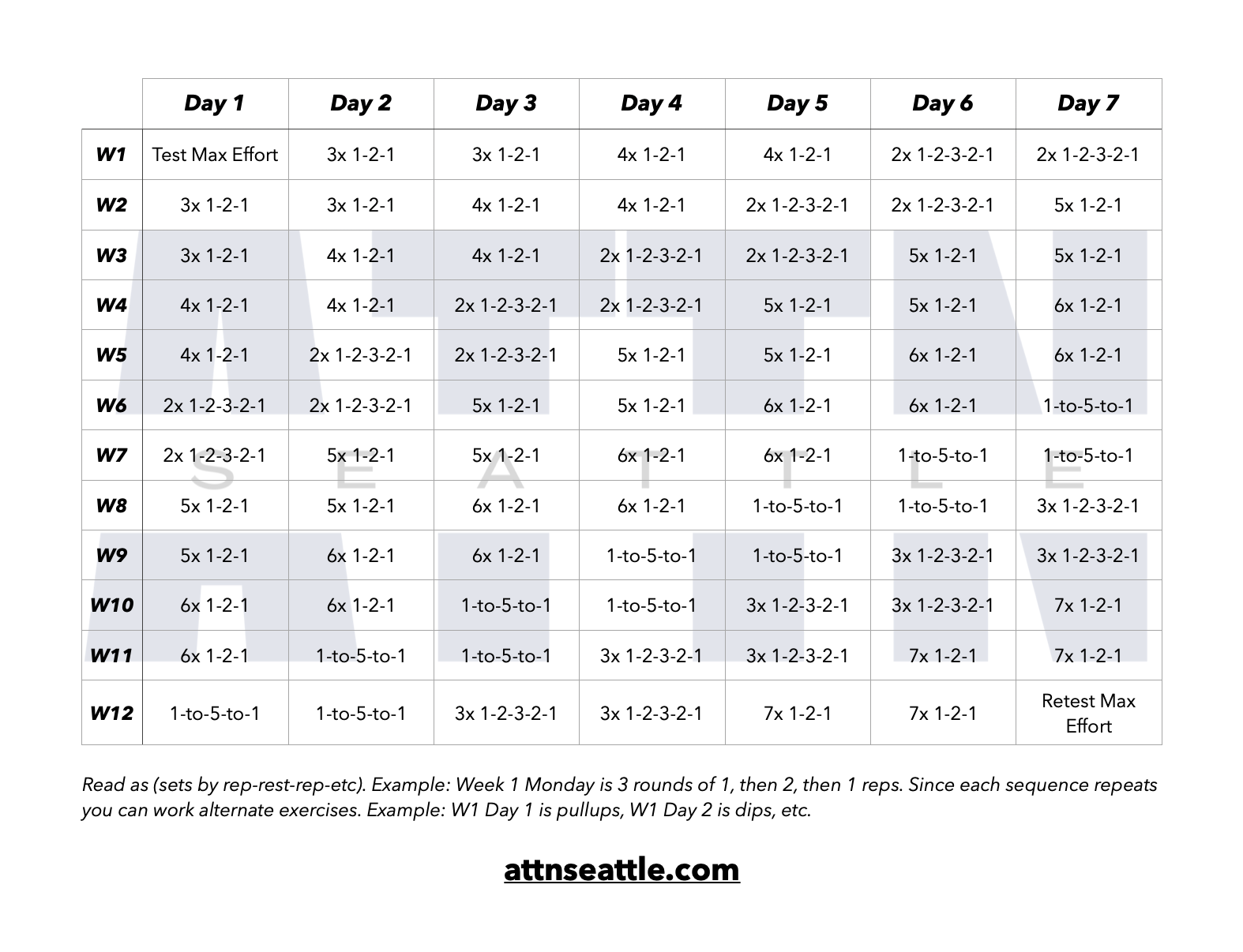
It should go without saying that this protocol can still work at less than 7 days a week. You could go in order at your own pace:
Day 1 - W1D2
Day 2 - W1D3
Day 3 - W1D4
Day 4 - W1D5
Day 5 - W1D6
Day 6 - W1D7
Or you can skip ahead and find where the table overlays a calendar:
Monday - W1D2
Wednesday - W1D4
Friday - W1D6
Next Monday - W2D2
Next Wednesday - W2D4
Next Friday - W2D6
Get creative- frameworks are always better than some 100% completion of a program built off someone’s decisions.
I’ve only seen huge positive changes for those dedicated to sticking with the program consistently. Try it out and see what kind of progress you can make in your fitness!
IN USE
Practically how does one use this?
1.) A Simple Movement
If the goal is singular (getting better at pullups) I suggest alternating between two variations of movement. In our case of the pullup maybe these two movements are (a.) jumping pullup negatives and (b.) ring rows. Note in the table above each sequence repeats two days at a time. W1D2 could movement (a.) and W1D3 could be movement (b.), allowing you to recover while still building strength in the shoulder girdle. W1D4 would go back to (a.) and the alternating of days would continue.
One of my bigger training philosophy tenants is avoiding “junk volume” and overuse injuries. I believe training can be done on the daily if you have enough variation. There are benefits to this concepts too: you build more of the supporting muscles and you’re testing more coordination and mechanics.
2.) A Complex Movement
Let’s upgrade the goal from a pullup into a muscle-up. At its core the muscle-up is a highly-elevated pullup transitioning into the lowest-possible dip. W1D2 could be pullups, W1D3 could be dips. Alternatively we can focus on transition drills (example) within the muscle-up. This is all highly dependent on the athlete and their current skillset but hopefully the ideas help.
Again, framework is the key. Consistency moves the chains.
3.) Endurance
Maybe this all sounds silly because you can barely hang on a bar- great! This works for you too!
Instead of doing reps of a skill you don’t have, let’s think of building a foundation- instead of a 3x 1-2-1 you can do a :10 dead hang, a quick break, a :20 dead hang, a quick break, then another :10 hang. Rest until your hands, forearms, and shoulders are fully rested. Repeat until you complete 3 rounds.
4.) Turning One into Some
On the other end of that smaller spectrum we can work a simple single kipping pullup into many by using this practice as “attempts”.
In a 3x 1-2-1 it might be a good rep, a good rep + a not-so-good rep + another good rep. The big takeaway here is either extending or shortening the rest times between reps and between sets.
